01 · Understand
Learn how the business actually uses the numbers
Requirements come from decisions, workflows, definitions and exceptions — not just the columns available in a source table.
A selection of founder delivery experience and previous independent client work, with organisations unnamed and the two types of experience labelled separately below. The useful proof is what had to be understood, connected and simplified to make the reporting reliable.
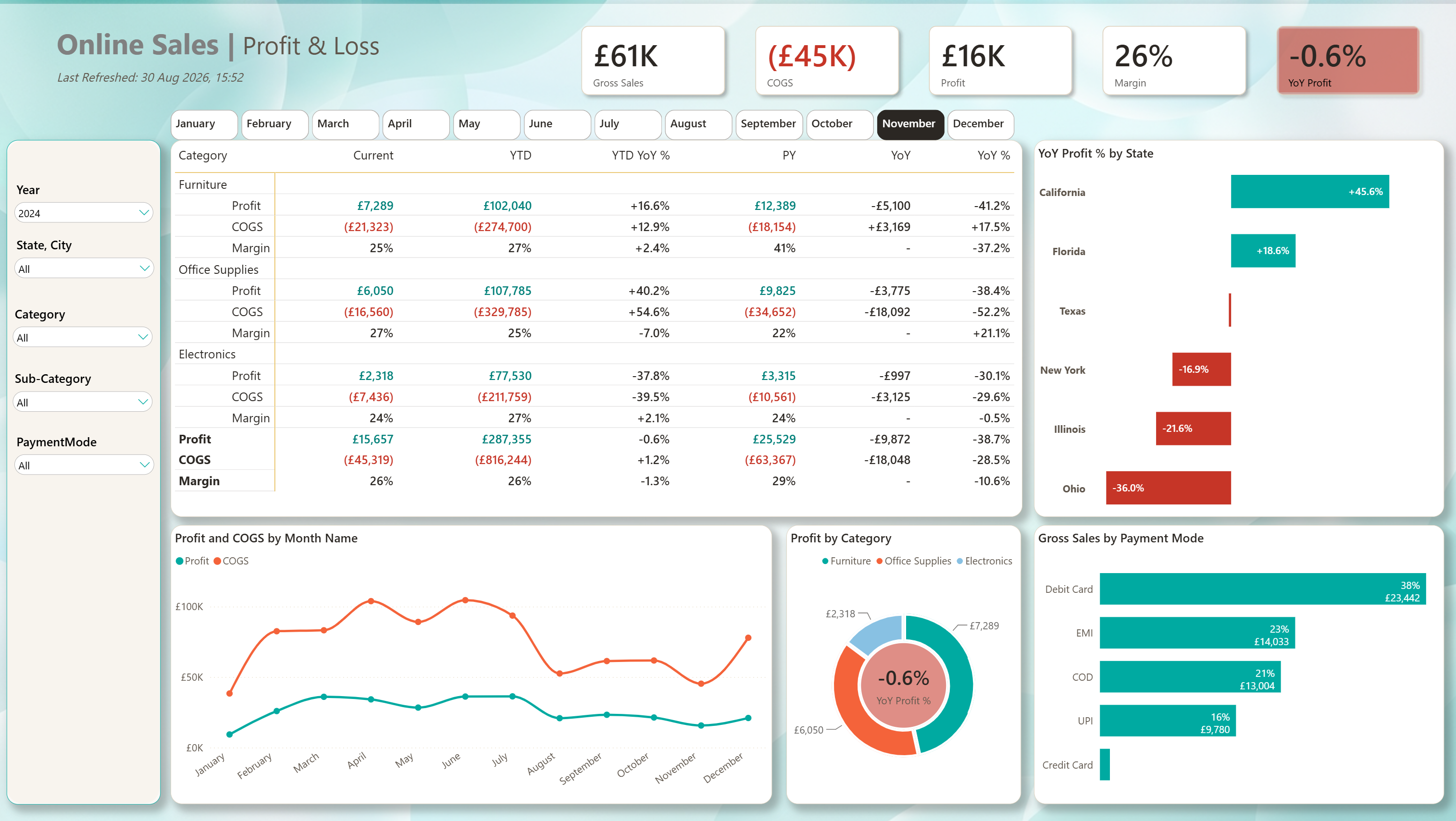
Portfolio visual recreated using non-confidential example data.
The challenge. A long-established financial reporting process relied on a complex set of Excel workbooks and accumulated manual logic. The work involved multiple business functions and required the existing dependencies and calculations to be understood before the reporting could be rebuilt.
The delivery. In an in-house role, StrategiQ Analytics’ founder independently handled the Power BI delivery end to end — learning unfamiliar accounting logic, tracing source data, validating inherited calculations, designing the model and measures, building the reporting experience, deploying it and supporting handover.
Recreated portfolio view using non-confidential example data. It represents the type of reporting delivered. The example shows how management reporting can be organised for review and drill-down.
The challenge. A UK waste and logistics operator needed a clearer view of site throughput, load-in versus load-out volumes and operational trends without relying on recurring manual preparation to make the data useful.
The delivery. StrategiQ Analytics’ founder built the Power BI solution from the operational source data through to the finished reporting experience, replacing repeated reporting preparation with a clearer day-to-day view of throughput and trends.
Different industries, different data and different scale — but the same basic pattern: understand the process, get control of the data and make the reporting easier to trust and maintain.
Requirements come from decisions, workflows, definitions and exceptions — not just the columns available in a source table.
Good BI does the difficult joins, transformations and calculations once so teams do not keep rebuilding them manually.
The model, refresh process and reporting experience should remain understandable after the original developer steps away.
One source or several. Finance, operations or something entirely different. Start with what the business is trying to do and what is making that harder than it should be.